Hiring remote talent can feel like a high-upside move with hidden risk. Employers are not just asking whether a candidate has the right skills. They are asking harder questions: Will this person communicate clearly? Can I trust their profile? Will they work independently without disappearing? Will I spend less time managing, or more? Those doubts show up again and again in manager discussions and HR guidance, especially around remote communication, visibility, and follow-through. (Reddit)
The good news is that employer doubt can be reduced. It does not disappear through optimism or volume hiring. It goes down when employers use better screening signals, ask better questions, and focus on the traits that actually make remote work succeed. Strong communication is one of the most important of those traits, and modern AI matching can help surface it faster when profiles are complete and well-structured. (SHRM)
Why employer doubt is so common in remote hiring
Remote hiring removes many of the signals managers used to rely on in office settings. There is no quick hallway check-in, no visual sense of responsiveness, and no casual observation of how someone handles day-to-day work. As a result, employers often worry more about communication, reliability, and self-management than they would in a fully on-site role. Society for Human Resource Management guidance on remote teams and remote soft skills consistently highlights communication, independence, organization, and adaptability as critical traits for successful remote work. (SHRM)
Manager discussions show the same pattern from a more practical angle. One common frustration is not knowing where work stands because the employee gives no proactive updates. Another is the opposite problem: too many interruptions, too many calls, and too much unstructured communication. In other words, employers are not simply looking for “someone who talks a lot.” They want someone who communicates clearly, updates appropriately, and reduces uncertainty instead of creating more of it. (Reddit)
The main hesitations employers have
When hiring remote talent, especially someone they have never worked with before, employers often hesitate around five practical concerns.
1. “Can I trust that this person is real and serious?”
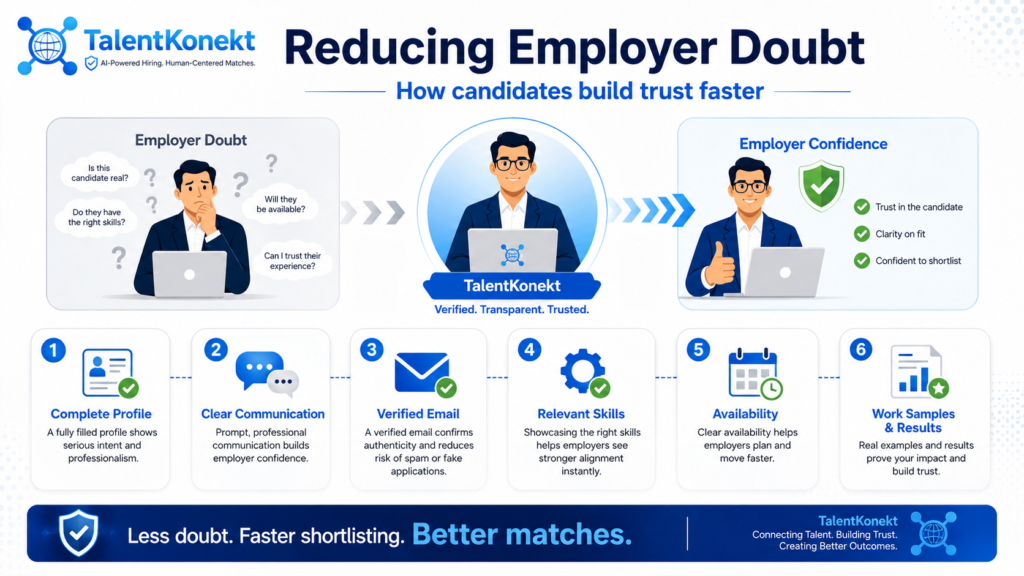
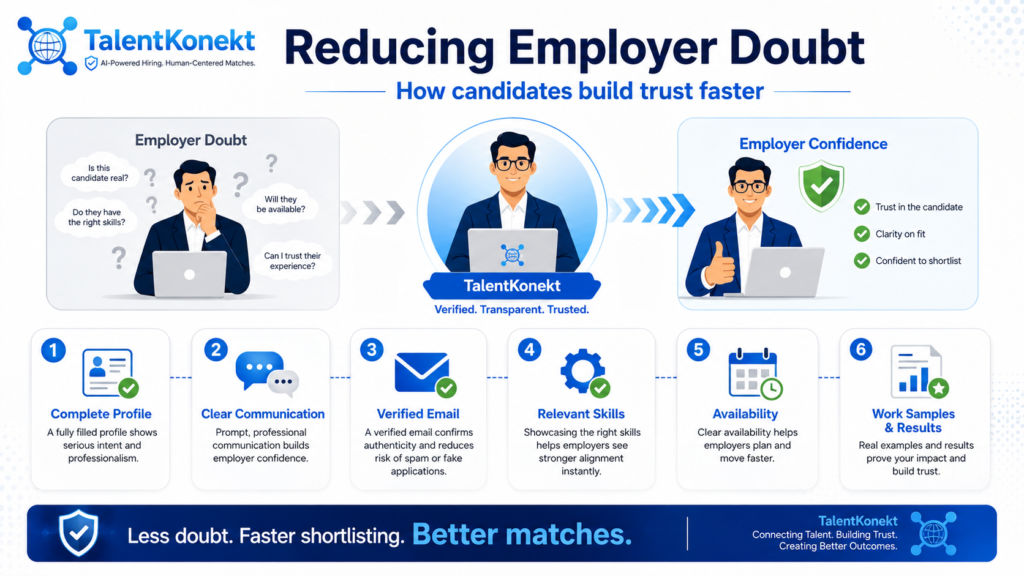
A polished profile alone does not remove doubt. Employers want signals that the person is real, reachable, and professionally invested. Clear profile information, consistent work history, strong written communication, and visible verification signals all help reduce that concern.
2. “Will this person communicate well without being chased?”
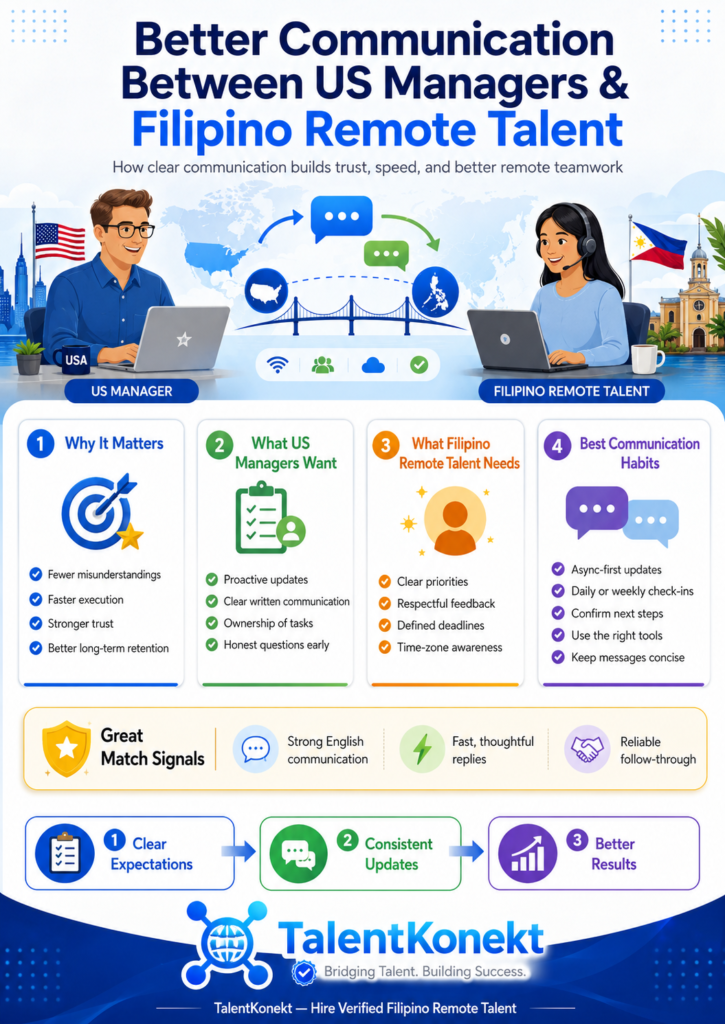
This is one of the biggest concerns managers express online. The problem is not only delayed replies. It is the lack of proactive updates and the feeling that the manager has to chase basic status information. That quickly turns into micromanagement, which most employers want to avoid. (Reddit)
3. “Can this person work independently?”
Remote work is not only about skill. It is also about prioritization, organization, and self-direction. SHRM’s remote management guidance explicitly points to the importance of independence, communication, reliability, and being results-oriented in remote environments. (SHRM)
4. “Will communication become a source of friction?”
Poor communication creates hidden costs: duplicated work, unclear deadlines, repeated explanations, unnecessary meetings, and missed expectations. Recent reporting on workplace communication found that unclear messages are causing real productivity losses and repeated clarification work across teams. (IT Pro)
5. “How do I know this person is the right fit before I spend weeks interviewing?”
This is where structured screening and better matching matter. Skills-based and AI-assisted hiring approaches are increasingly used to help employers narrow candidates more intelligently and reduce guesswork earlier in the funnel. (PMC)
How employers can detect strong communication skills early
Communication ability should not be treated like a vague impression. It can be assessed in practical ways.
Review the profile itself
Start with the easiest signal: the candidate profile. Is the summary clear, specific, and easy to understand? Are job titles and experience consistent? Are tools, languages, and work preferences visible? A profile that is vague or messy often creates the first layer of doubt. A profile that is complete and well-organized builds trust faster.
Notice response quality, not just speed
Fast replies are useful, but quality matters more. Good remote communicators usually do three things well:
- they answer the actual question,
- they add relevant context,
- and they make the next step easier.
A strong reply reduces confusion. A weak reply forces another clarification.
Look for evidence of async maturity
Remote work depends heavily on asynchronous communication. Good candidates are often strong at written updates, documenting decisions, and summarizing progress without needing a meeting for everything. Harvard Business Review has emphasized the importance of intentional remote collaboration and more asynchronous ways of working. (SHRM)
Ask for examples, not self-descriptions
Many candidates say they are “great communicators.” That statement means very little on its own. Ask for examples of how they handled client updates, deadline risks, project handoffs, or unclear instructions in previous roles. The way they explain their process often reveals more than the claim itself.
Questions employers can ask to reduce doubt
These kinds of interview questions can help identify whether a remote candidate is likely to communicate well and work with low friction.
Questions about proactive communication
- Tell me about a time a task was at risk of delay. How did you communicate it?
- How do you usually keep a manager or client updated without being asked?
- What information do you include in a good progress update?
Questions about written clarity
- If I gave you a task with incomplete instructions, what would you do first?
- How do you decide whether to send a message, write a summary, or schedule a call?
- Can you give an example of a time you had to explain something complex in writing?
Questions about ownership and remote discipline
- How do you organize your work when you have multiple priorities?
- How do you make sure you do not miss important messages or deadlines?
- What do you do when you are blocked and need help?
Questions about collaboration style
- How do you work with teammates across different time zones?
- What tools have you used for remote collaboration, and how did you use them?
- What makes communication effective on a remote team?
The goal of these questions is not to hear polished buzzwords. It is to see whether the candidate thinks clearly, communicates concretely, and understands the practical demands of remote work.
Tips that help employers hire with more confidence
1. Prioritize clarity over charisma
Some candidates are warm and engaging but vague. Others are more straightforward and much easier to work with. In remote roles, clarity often matters more than charm.
2. Use a short paid test task where appropriate
For roles involving writing, support, admin, or coordination, a short sample task can reveal a lot. It shows how the candidate interprets instructions, structures responses, and communicates under realistic conditions.
3. Look for consistency across profile, CV, and conversation
If the profile says one thing, the resume says another, and the interview creates a third impression, doubt goes up. Consistency builds credibility.
4. Screen for communication fit, not just technical fit
A technically capable candidate who creates confusion can cost more than a slightly less advanced candidate who communicates clearly, follows through, and works reliably in remote settings.
5. Make your own expectations clearer
Employers sometimes create doubt for themselves by asking vague questions or not defining the role well. Clear job descriptions, clear outcomes, and clear communication expectations make it easier to identify the right person.
How AI matching helps reduce employer doubt
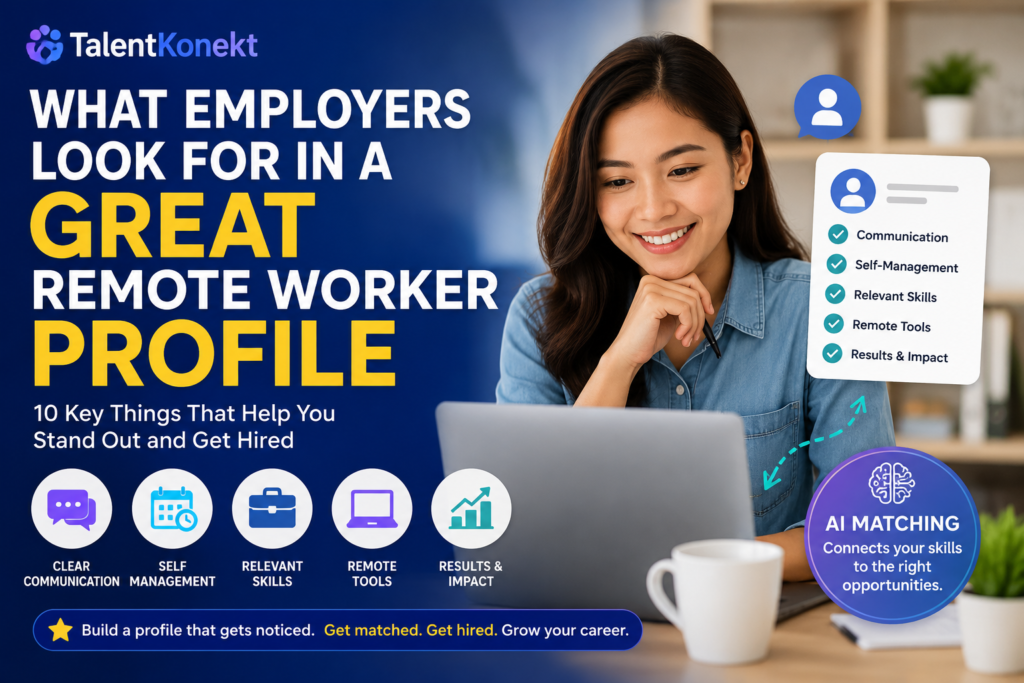
AI matching is most useful when it reduces noise and increases relevance. In hiring, AI can help identify candidates who align with required skills, experience, and role fit more quickly than manual sorting alone. Research on AI in recruitment highlights its ability to support people-job fit and help narrow large candidate pools. (PMC)
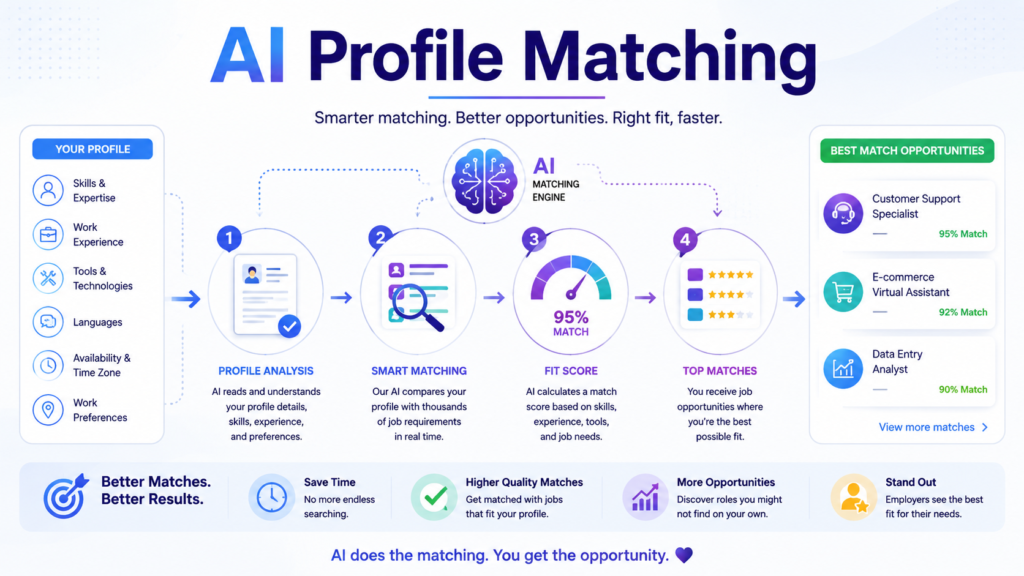
For employers on a platform like TalentKonekt, that means AI matching can help by:
- surfacing more relevant candidates sooner,
- reducing time spent reviewing weak matches,
- identifying fit based on multiple profile signals,
- and helping employers focus their attention where the chance of success is higher.
That does not mean AI removes human judgment. It should not. It works best as a confidence-building layer, not as a replacement for employer evaluation.
How AI matching increases the chance of finding the right person
The strongest benefit of AI matching is not that it “finds talent magically.” The benefit is that it can process structured profile information at scale and connect patterns faster than manual browsing alone.
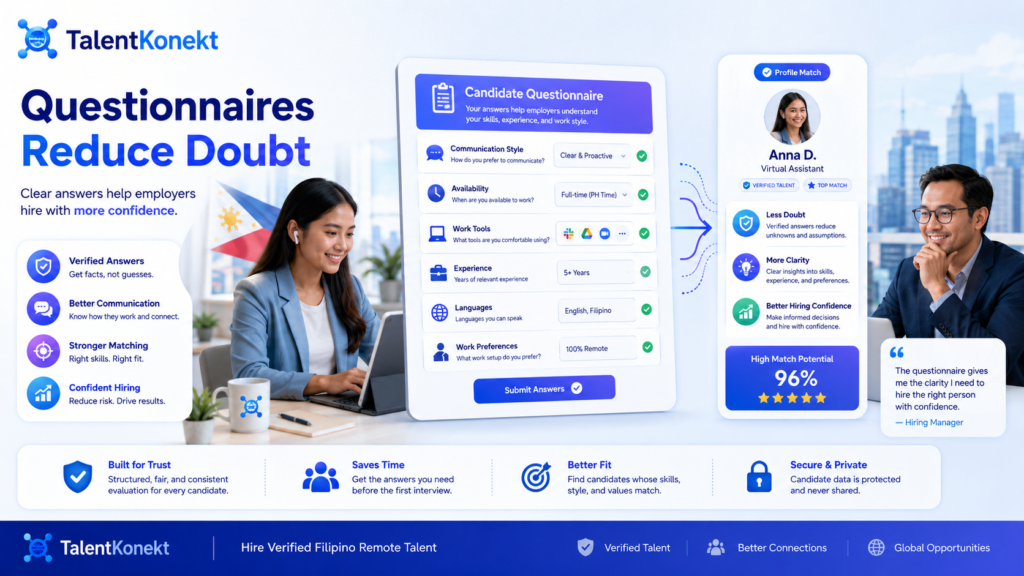
When candidate profiles are complete, AI matching can use signals like:
- role-specific skills,
- work history,
- tools and technologies,
- language ability,
- availability,
- and career preferences
to identify candidates who are more likely to fit the role. That reduces random browsing and increases the chance that the employer sees candidates who are worth serious attention.
For employers, this lowers a specific form of doubt: the fear that the right person is buried under too many weak or irrelevant profiles.
What employers should look for on TalentKonekt
To reduce doubt faster, focus on candidates who show:
- a complete and specific profile,
- clear written communication,
- consistency across sections,
- role-relevant skills,
- tools they actually use,
- language visibility,
- availability clarity,
- and evidence of ownership or independent work.
Those signals do not guarantee success, but they significantly improve the odds of finding someone who will be easier to trust and easier to manage remotely.
Final takeaway
Employer doubt in remote hiring is normal. It comes from real concerns: unclear communication, lack of visibility, weak follow-through, and the risk of hiring someone who creates more management overhead than value. The answer is not blind trust. The answer is better filtering.
When employers screen intentionally for communication quality, ownership, and profile clarity, they reduce uncertainty. And when AI matching is layered on top of complete, structured profiles, it helps surface stronger candidates faster and with less noise.
That is how remote hiring becomes less risky: not by removing judgment, but by improving the signals you use to make it.
FAQ
Why do employers have more doubt in remote hiring?
Because remote work removes many of the signals managers rely on in office settings, such as direct visibility, spontaneous updates, and informal observation. That makes communication and self-management more important. (SHRM)
What is the biggest communication red flag in remote candidates?
A lack of proactive updates is one of the most common manager frustrations. Employers do not want to chase basic status information. (Reddit)
How can employers test communication skills during hiring?
They can ask scenario-based questions, review written responses carefully, compare profile clarity with interview clarity, and use short sample tasks where relevant.
How does AI matching help employers?
AI matching can reduce noise, improve relevance, and surface stronger-fit candidates faster by comparing profile signals such as skills, experience, and preferences. (PMC)
Does AI matching replace employer judgment?
No. It works best as a tool that reduces uncertainty and improves candidate discovery, while the employer still evaluates communication, fit, and reliability.