Category: Hiring Guides

  • Reducing Employer Doubt in Remote Hiring: How to Find the Right Talent With More Confidence

    Reducing Employer Doubt in Remote Hiring: How to Find the Right Talent With More Confidence

    Hiring remote talent can feel like a high-upside move with hidden risk. Employers are not just asking whether a candidate has the right skills. They are asking harder questions: Will this person communicate clearly? Can I trust their profile? Will they work independently without disappearing? Will I spend less time managing, or more? Those doubts show up again and again in manager discussions and HR guidance, especially around remote communication, visibility, and follow-through. (Reddit)

    The good news is that employer doubt can be reduced. It does not disappear through optimism or volume hiring. It goes down when employers use better screening signals, ask better questions, and focus on the traits that actually make remote work succeed. Strong communication is one of the most important of those traits, and modern AI matching can help surface it faster when profiles are complete and well-structured. (SHRM)

    Why employer doubt is so common in remote hiring

    Remote hiring removes many of the signals managers used to rely on in office settings. There is no quick hallway check-in, no visual sense of responsiveness, and no casual observation of how someone handles day-to-day work. As a result, employers often worry more about communication, reliability, and self-management than they would in a fully on-site role. Society for Human Resource Management guidance on remote teams and remote soft skills consistently highlights communication, independence, organization, and adaptability as critical traits for successful remote work. (SHRM)

    Manager discussions show the same pattern from a more practical angle. One common frustration is not knowing where work stands because the employee gives no proactive updates. Another is the opposite problem: too many interruptions, too many calls, and too much unstructured communication. In other words, employers are not simply looking for “someone who talks a lot.” They want someone who communicates clearly, updates appropriately, and reduces uncertainty instead of creating more of it. (Reddit)

    The main hesitations employers have

    When hiring remote talent, especially someone they have never worked with before, employers often hesitate around five practical concerns.

    1. “Can I trust that this person is real and serious?”

    A polished profile alone does not remove doubt. Employers want signals that the person is real, reachable, and professionally invested. Clear profile information, consistent work history, strong written communication, and visible verification signals all help reduce that concern.

    2. “Will this person communicate well without being chased?”

    This is one of the biggest concerns managers express online. The problem is not only delayed replies. It is the lack of proactive updates and the feeling that the manager has to chase basic status information. That quickly turns into micromanagement, which most employers want to avoid. (Reddit)

    3. “Can this person work independently?”

    Remote work is not only about skill. It is also about prioritization, organization, and self-direction. SHRM’s remote management guidance explicitly points to the importance of independence, communication, reliability, and being results-oriented in remote environments. (SHRM)

    4. “Will communication become a source of friction?”

    Poor communication creates hidden costs: duplicated work, unclear deadlines, repeated explanations, unnecessary meetings, and missed expectations. Recent reporting on workplace communication found that unclear messages are causing real productivity losses and repeated clarification work across teams. (IT Pro)

    5. “How do I know this person is the right fit before I spend weeks interviewing?”

    This is where structured screening and better matching matter. Skills-based and AI-assisted hiring approaches are increasingly used to help employers narrow candidates more intelligently and reduce guesswork earlier in the funnel. (PMC)

    How employers can detect strong communication skills early
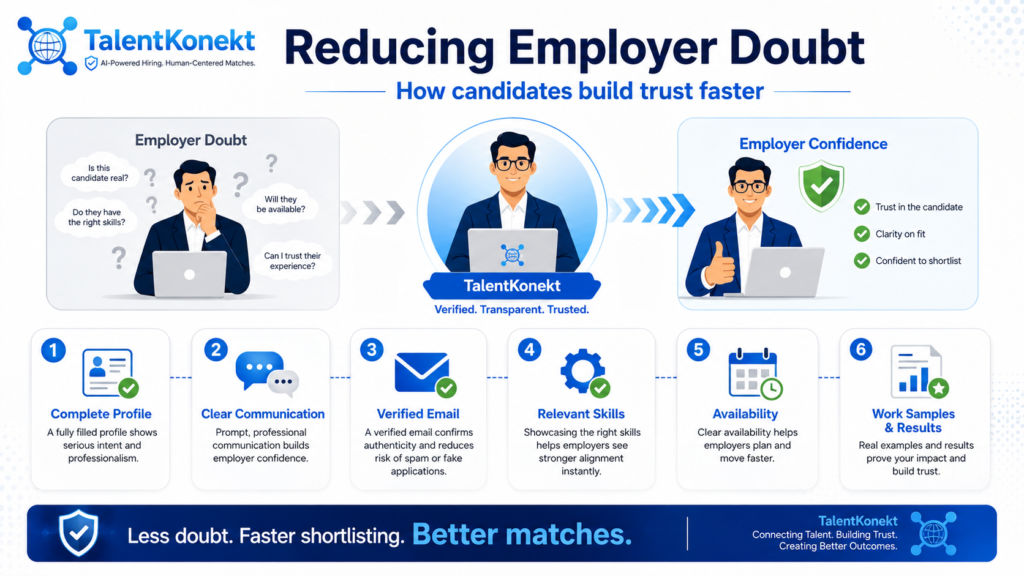
    Communication ability should not be treated like a vague impression. It can be assessed in practical ways.

    Review the profile itself

    Start with the easiest signal: the candidate profile. Is the summary clear, specific, and easy to understand? Are job titles and experience consistent? Are tools, languages, and work preferences visible? A profile that is vague or messy often creates the first layer of doubt. A profile that is complete and well-organized builds trust faster.

    Notice response quality, not just speed

    Fast replies are useful, but quality matters more. Good remote communicators usually do three things well:

    • they answer the actual question,
    • they add relevant context,
    • and they make the next step easier.

    A strong reply reduces confusion. A weak reply forces another clarification.

    Look for evidence of async maturity

    Remote work depends heavily on asynchronous communication. Good candidates are often strong at written updates, documenting decisions, and summarizing progress without needing a meeting for everything. Harvard Business Review has emphasized the importance of intentional remote collaboration and more asynchronous ways of working. (SHRM)

    Ask for examples, not self-descriptions

    Many candidates say they are “great communicators.” That statement means very little on its own. Ask for examples of how they handled client updates, deadline risks, project handoffs, or unclear instructions in previous roles. The way they explain their process often reveals more than the claim itself.

    Questions employers can ask to reduce doubt

    These kinds of interview questions can help identify whether a remote candidate is likely to communicate well and work with low friction.

    Questions about proactive communication

    • Tell me about a time a task was at risk of delay. How did you communicate it?
    • How do you usually keep a manager or client updated without being asked?
    • What information do you include in a good progress update?

    Questions about written clarity

    • If I gave you a task with incomplete instructions, what would you do first?
    • How do you decide whether to send a message, write a summary, or schedule a call?
    • Can you give an example of a time you had to explain something complex in writing?

    Questions about ownership and remote discipline

    • How do you organize your work when you have multiple priorities?
    • How do you make sure you do not miss important messages or deadlines?
    • What do you do when you are blocked and need help?

    Questions about collaboration style

    • How do you work with teammates across different time zones?
    • What tools have you used for remote collaboration, and how did you use them?
    • What makes communication effective on a remote team?

    The goal of these questions is not to hear polished buzzwords. It is to see whether the candidate thinks clearly, communicates concretely, and understands the practical demands of remote work.
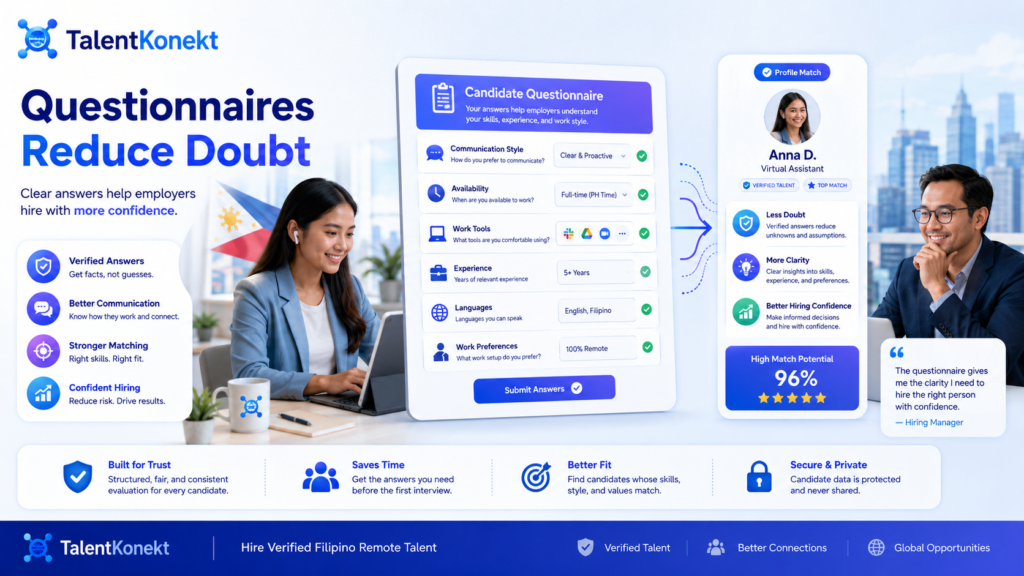
    Tips that help employers hire with more confidence

    1. Prioritize clarity over charisma

    Some candidates are warm and engaging but vague. Others are more straightforward and much easier to work with. In remote roles, clarity often matters more than charm.

    2. Use a short paid test task where appropriate

    For roles involving writing, support, admin, or coordination, a short sample task can reveal a lot. It shows how the candidate interprets instructions, structures responses, and communicates under realistic conditions.

    3. Look for consistency across profile, CV, and conversation

    If the profile says one thing, the resume says another, and the interview creates a third impression, doubt goes up. Consistency builds credibility.

    4. Screen for communication fit, not just technical fit

    A technically capable candidate who creates confusion can cost more than a slightly less advanced candidate who communicates clearly, follows through, and works reliably in remote settings.

    5. Make your own expectations clearer

    Employers sometimes create doubt for themselves by asking vague questions or not defining the role well. Clear job descriptions, clear outcomes, and clear communication expectations make it easier to identify the right person.

    How AI matching helps reduce employer doubt

    AI matching is most useful when it reduces noise and increases relevance. In hiring, AI can help identify candidates who align with required skills, experience, and role fit more quickly than manual sorting alone. Research on AI in recruitment highlights its ability to support people-job fit and help narrow large candidate pools. (PMC)
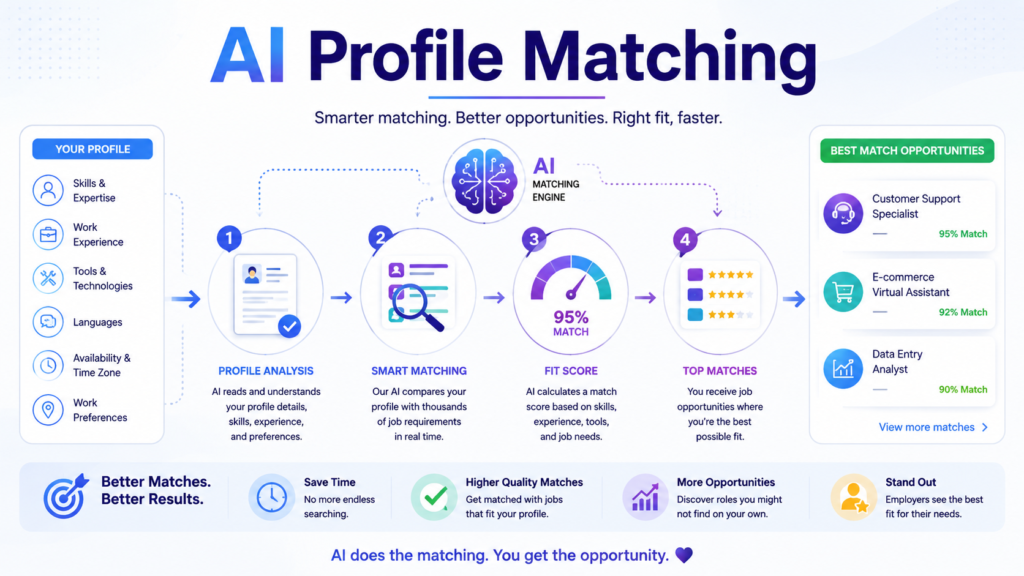
    For employers on a platform like TalentKonekt, that means AI matching can help by:

    • surfacing more relevant candidates sooner,
    • reducing time spent reviewing weak matches,
    • identifying fit based on multiple profile signals,
    • and helping employers focus their attention where the chance of success is higher.

    That does not mean AI removes human judgment. It should not. It works best as a confidence-building layer, not as a replacement for employer evaluation.

    How AI matching increases the chance of finding the right person

    The strongest benefit of AI matching is not that it “finds talent magically.” The benefit is that it can process structured profile information at scale and connect patterns faster than manual browsing alone.

    When candidate profiles are complete, AI matching can use signals like:

    • role-specific skills,
    • work history,
    • tools and technologies,
    • language ability,
    • availability,
    • and career preferences

    to identify candidates who are more likely to fit the role. That reduces random browsing and increases the chance that the employer sees candidates who are worth serious attention.

    For employers, this lowers a specific form of doubt: the fear that the right person is buried under too many weak or irrelevant profiles.

    What employers should look for on TalentKonekt

    To reduce doubt faster, focus on candidates who show:

    • a complete and specific profile,
    • clear written communication,
    • consistency across sections,
    • role-relevant skills,
    • tools they actually use,
    • language visibility,
    • availability clarity,
    • and evidence of ownership or independent work.

    Those signals do not guarantee success, but they significantly improve the odds of finding someone who will be easier to trust and easier to manage remotely.

    Final takeaway

    Employer doubt in remote hiring is normal. It comes from real concerns: unclear communication, lack of visibility, weak follow-through, and the risk of hiring someone who creates more management overhead than value. The answer is not blind trust. The answer is better filtering.

    When employers screen intentionally for communication quality, ownership, and profile clarity, they reduce uncertainty. And when AI matching is layered on top of complete, structured profiles, it helps surface stronger candidates faster and with less noise.

    That is how remote hiring becomes less risky: not by removing judgment, but by improving the signals you use to make it.

    FAQ

    Why do employers have more doubt in remote hiring?

    Because remote work removes many of the signals managers rely on in office settings, such as direct visibility, spontaneous updates, and informal observation. That makes communication and self-management more important. (SHRM)

    What is the biggest communication red flag in remote candidates?

    A lack of proactive updates is one of the most common manager frustrations. Employers do not want to chase basic status information. (Reddit)

    How can employers test communication skills during hiring?

    They can ask scenario-based questions, review written responses carefully, compare profile clarity with interview clarity, and use short sample tasks where relevant.

    How does AI matching help employers?

    AI matching can reduce noise, improve relevance, and surface stronger-fit candidates faster by comparing profile signals such as skills, experience, and preferences. (PMC)

    Does AI matching replace employer judgment?

    No. It works best as a tool that reduces uncertainty and improves candidate discovery, while the employer still evaluates communication, fit, and reliability.
  • How to Hire a Filipino Virtual Assistant Who Actually Makes Your Life Easier

    How to Hire a Filipino Virtual Assistant Who Actually Makes Your Life Easier

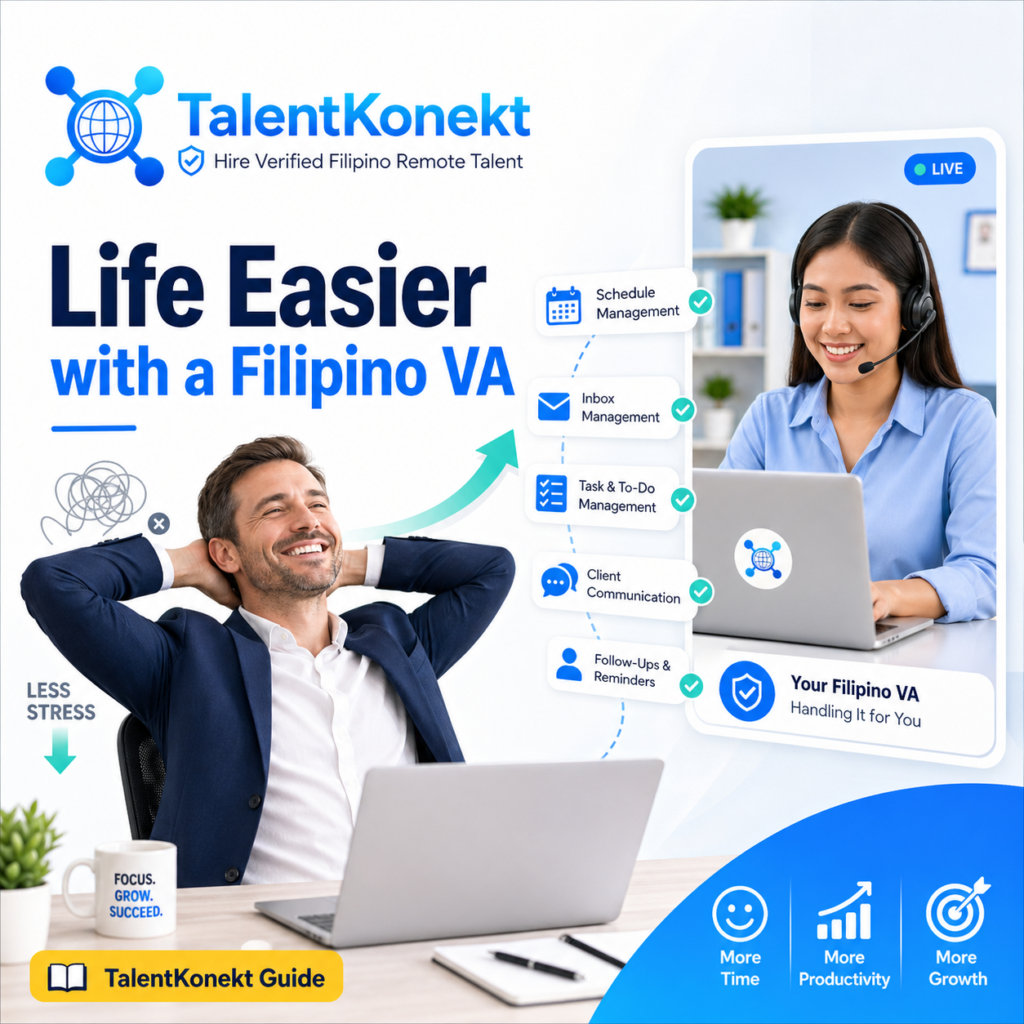
    Hiring a Filipino virtual assistant can be one of the smartest moves a growing business makes. The right VA can reduce founder overload, improve daily operations, and free up time for higher-value work. But many companies make the mistake of hiring too quickly, defining the role too vaguely, or focusing only on cost instead of fit.

    That is where things go wrong.

    If you want to hire a Filipino virtual assistant who truly makes your life easier, you need more than a basic job post. You need a clear role, realistic expectations, and a hiring process that helps you find someone who can communicate well, take ownership, and support your business in practical ways.

    This guide explains how to do that.

    Why so many businesses hire Filipino virtual assistants

    Filipino virtual assistants are in demand because they often bring strong English communication, professionalism, adaptability, and experience working with international clients. They are commonly hired for admin support, inbox management, calendar coordination, customer service, ecommerce support, research, data entry, and operational follow-up.

    For startups and lean companies, that kind of support can be extremely valuable.

    A good VA does not just complete tasks. A good VA reduces mental load. Instead of the founder remembering every small detail, following up on every email, and handling every recurring admin task, the VA becomes a reliable extension of the business.

    That is the real benefit.

    What a virtual assistant should actually do

    One of the biggest hiring mistakes is trying to hire a “do everything” assistant. That usually leads to confusion on both sides.

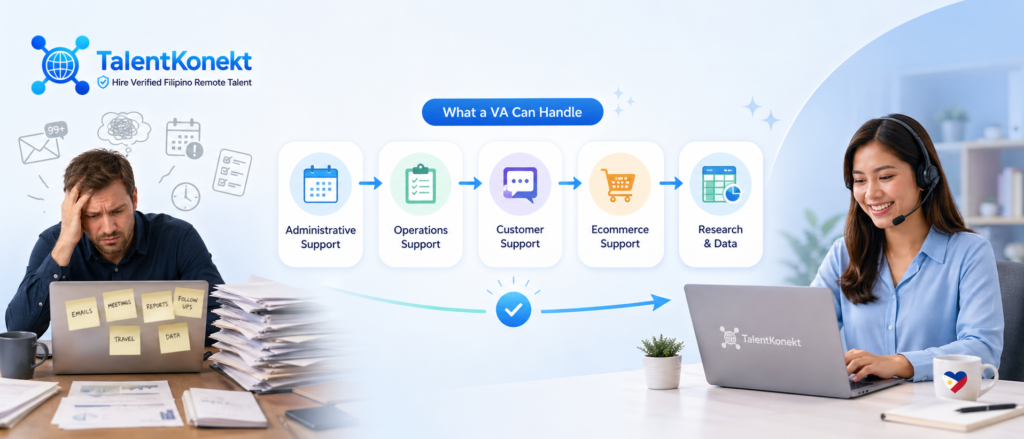
    Before hiring, decide what kind of help you actually need. In many cases, the role fits into one or more of these categories:

    Administrative support

    • calendar management
    • inbox organization
    • appointment scheduling
    • travel planning
    • document preparation
    • meeting notes

    Operations support

    • follow-ups
    • CRM updates
    • task coordination
    • internal reporting
    • spreadsheet maintenance
    • process tracking

    Customer-facing support

    • email support
    • chat support
    • order follow-up
    • customer issue routing
    • support ticket handling

    Ecommerce support

    • product uploads
    • order monitoring
    • listing updates
    • inventory checks
    • marketplace admin
    • store content updates

    Research and data work

    • lead research
    • market research
    • supplier research
    • data entry
    • data cleanup
    • information gathering

    The more clearly you define the role, the better your chances of hiring someone who actually fits.

    The difference between a helpful VA and a frustrating one

    A helpful virtual assistant usually has these qualities:

    • communicates clearly
    • understands instructions well
    • asks smart questions
    • follows through
    • notices details
    • keeps things organized
    • becomes more independent over time

    A frustrating VA usually creates more work because they:

    • need constant re-explaining
    • miss context
    • forget recurring instructions
    • wait too long to ask questions
    • do tasks mechanically without ownership
    • communicate too vaguely

    That is why hiring based on price alone is risky. A cheaper assistant who creates confusion can cost you more in lost time, mistakes, and mental energy.

    How to write a job post that attracts the right Filipino virtual assistant

    A vague job post brings vague applicants. If you want stronger candidates, your job post should be specific, realistic, and written around outcomes.

    Bad example

    We need a virtual assistant to help with different tasks.

    Better example

    We are looking for a Filipino virtual assistant to support daily operations, manage inbox and calendar tasks, update spreadsheets, follow up on open items, and help keep our workflow organized. Strong written English, attention to detail, and reliability are important.

    Include these elements in your job post:

    • what the company does
    • what the VA will do weekly
    • what tools they will use
    • what time overlap you need
    • what communication style you expect
    • what success looks like after 30 to 60 days

    This helps serious candidates understand the role and discourages poor-fit applicants.

    Skills to look for in a Filipino virtual assistant

    Not every virtual assistant is the same. Some are stronger in admin work, others in customer support, ecommerce, social media, or project coordination.

    Look for a match between the candidate’s strengths and your actual business needs.

    Common skills worth checking include:

    • written English
    • calendar and inbox management
    • Microsoft Office or Google Workspace
    • spreadsheet confidence
    • task management tools
    • customer support handling
    • ecommerce platform familiarity
    • CRM usage
    • research ability
    • attention to detail

    Depending on your company, useful bonus skills may include:

    • WordPress
    • Shopify
    • Magento
    • Canva
    • bookkeeping basics
    • social media support
    • AI tool familiarity
    • automation tools like Zapier, Make, or n8n

    How to tell if a candidate will really make your life easier

    This is the key question.

    A polished profile is not enough. A nice interview is not enough. You need signals that the person can reduce workload in real business situations.

    Here is what to test.

    1. Communication clarity

    Give the candidate a short written scenario and ask how they would respond.

    For example:
    A customer asks where their order is, an internal spreadsheet is missing data, and your calendar has two overlapping meetings. How would you handle these?

    This reveals how they think, prioritize, and communicate.

    2. Attention to detail

    Include one small instruction in the job post that filters for careful readers.

    For example:
    Please begin your application with the words “organized support.”

    This simple step helps identify candidates who actually read instructions.

    3. Practical task ability

    Give a short paid test task. Keep it realistic.

    Examples:

    • organize a messy inbox sample
    • clean up a spreadsheet
    • draft a customer reply
    • summarize a set of notes
    • research 10 leads in a specific niche

    A short test is often more valuable than a long interview.

    4. Initiative

    Pay attention to whether the candidate only answers questions or also notices better ways to do the work.

    The best VAs often say things like:

    • I noticed a simpler way to track this
    • I would suggest using a template here
    • this step may create confusion later

    That kind of thinking matters.

    Common mistakes companies make when hiring a virtual assistant

    Hiring without defining the role

    If you are unclear, the assistant will also be unclear.

    Expecting one person to do five jobs

    Admin support, customer service, content creation, bookkeeping, and project management are not always the same role.

    Focusing only on hourly rate

    The better question is not “Who is cheapest?” but “Who will save me the most time and stress?”

    Skipping the test task

    Without a practical test, it is harder to judge fit.

    Not onboarding properly

    Even a great VA will struggle without clear context, systems, and expectations.

    How to onboard a Filipino virtual assistant successfully

    Hiring well matters. Onboarding well matters just as much.

    A new VA becomes effective faster when you provide:

    • clear priorities
    • standard operating procedures
    • examples of good work
    • access to tools
    • communication rules
    • escalation rules
    • expected turnaround times

    Start with a smaller set of responsibilities, then expand gradually. This gives the assistant time to learn your business and gives you time to evaluate strengths.

    The goal is not to dump tasks. The goal is to build trust and consistency.

    Signs you hired the right VA

    You know the hire is working when:

    • your inbox feels lighter
    • recurring tasks stop piling up
    • follow-ups happen without reminders
    • communication becomes easier
    • details are handled more reliably
    • you spend less time on low-value admin
    • your brain feels less crowded

    That is what businesses really want when they hire a virtual assistant. Not more activity. More relief.

    Why Filipino virtual assistants are especially attractive for growing companies

    For companies that need reliable remote support, Filipino virtual assistants are often a strong fit because they combine communication ability with flexibility and broad role coverage. Many already have experience supporting international clients and working inside structured remote processes.

    That makes them especially valuable for:

    • startups
    • ecommerce businesses
    • agencies
    • service businesses
    • founders with growing admin pressure

    The right person can become a long-term operational asset, not just a short-term helper.

    How TalentKonekt helps employers hire better virtual assistants

    Finding a VA should not mean sorting through endless low-fit applications. A better hiring process starts with better matching.

    TalentKonekt helps employers connect with Filipino remote talent more efficiently, making it easier to find candidates whose skills, communication style, and support strengths fit the role. That matters when the goal is not just to fill a position, but to find someone who will genuinely improve the way the business runs.

    Final takeaway

    If you want to hire a Filipino virtual assistant who actually makes your life easier, start by defining the role clearly. Focus on outcomes, not vague support. Test communication, detail, and initiative. Then onboard with structure.

    The right VA should not create more management overhead.

    They should reduce it.

    When hired well, a Filipino virtual assistant can help you stay organized, move faster, and spend more time on the work that really grows your business.

    Frequently asked questions

    What should a Filipino virtual assistant do?

    A Filipino virtual assistant can support admin, operations, research, customer support, ecommerce tasks, and day-to-day coordination, depending on the role.

    How do I know if a virtual assistant is a good fit?

    Use a clear job post, practical test task, and communication-based screening. Do not rely only on resumes or interviews.

    Why hire a Filipino virtual assistant?

    Many businesses hire Filipino virtual assistants because of strong English communication, professionalism, remote work readiness, and flexible support across many business functions.

    What is the biggest mistake when hiring a virtual assistant?

    The biggest mistake is hiring without clearly defining the role. That usually leads to poor fit, weak performance, and frustration on both sides.

    Can a virtual assistant really save time?

    Yes, if the role is defined properly and the person is a strong fit. A good VA reduces mental load, handles recurring tasks reliably, and helps the business run more smoothly.