What Employers Look for in a Great Remote Worker Profile
A great remote worker profile does more than list experience. It helps employers quickly answer one question: Can this person do excellent work remotely with minimal friction? Today’s remote hiring process is more competitive, more skills-focused, and more technology-driven than before. That means your profile needs to show clear communication, role-relevant skills, reliability, and strong fit for distributed work.
For Filipino freelancers and employees, this is good news. You do not need to sound flashy or overly corporate. But you do need a profile that makes employers feel confident that you are easy to work with, clear in communication, and capable of delivering results in a remote environment.
Why Remote Worker Profiles Matter More Now
Remote roles often attract large numbers of applicants, which means employers and recruiters make fast screening decisions. Your profile needs to work for both humans and modern hiring systems. A weak profile creates friction. A strong profile reduces it.
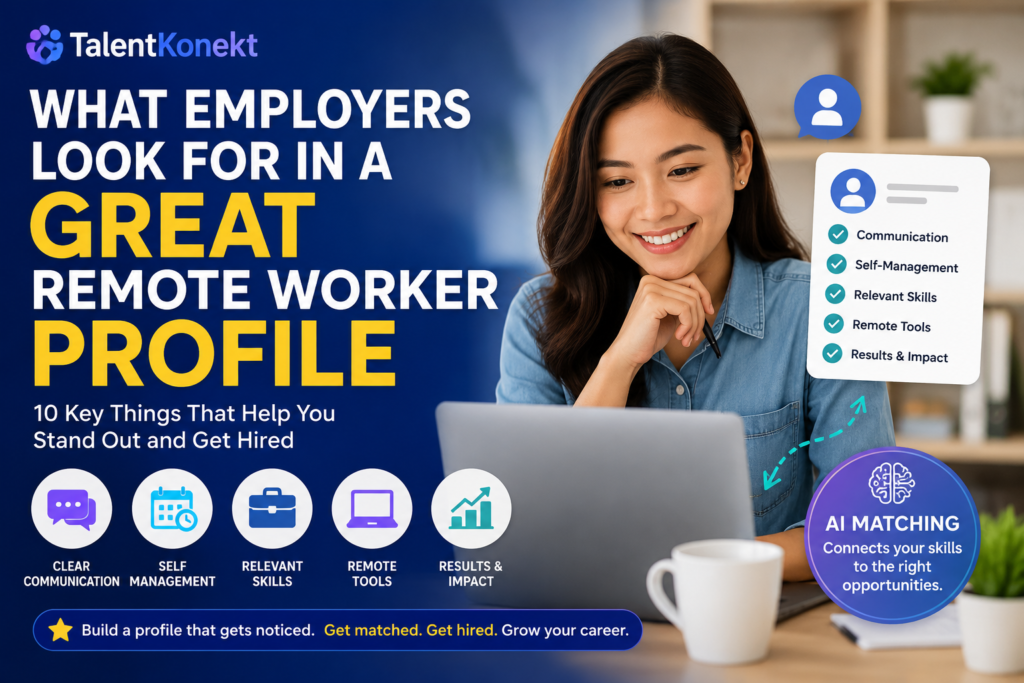
Employers want to understand your fit without guessing. They want to see what kind of work you do, how you communicate, what tools you use, and whether you can succeed without constant supervision. That is why a great remote worker profile is not just a biography. It is proof of remote readiness.
10 Things Employers Look For in a Great Remote Worker Profile
1. Clear Communication
Communication is one of the first things employers judge in a remote profile. If your summary is vague, confusing, or generic, employers may assume your day-to-day communication will be the same.
Your profile should show that you can write clearly, professionally, and with purpose. Instead of saying “I am hardworking and passionate,” explain what you do, who you support, and what kind of remote work you are best at.
2. Evidence of Self-Management
Remote employers want people who can manage their own work without constant supervision. They look for signs that you can stay organized, follow through, and handle responsibilities independently.
If you have managed schedules, customer communication, inboxes, reporting, follow-ups, research, or operational tasks on your own, make that visible. Employers want to see that you can keep things moving even when no one is watching over your shoulder.
3. Relevant Skills, Not Just Generic Claims
Employers do not want broad claims that could apply to anyone. They want to know whether your actual skills match their real needs.
That means your profile should list role-specific abilities. If you are a virtual assistant, mention calendar management, inbox management, appointment setting, travel planning, and data entry. If you are in ecommerce, mention Shopify, WooCommerce, Magento, product uploads, order support, and catalog work. Specific skills help employers understand where you fit best.
4. Familiarity With Remote Tools
A profile without tools can feel incomplete. Employers want to know what systems you already know how to use, because this reduces onboarding time and makes you easier to integrate into a remote team.
If you use Zoom, Slack, Trello, ClickUp, Asana, HubSpot, Google Workspace, Microsoft Office, Canva, Zendesk, Notion, or other role-specific tools, include them. This helps employers imagine you working inside their existing workflow.
5. A Consistent Professional Story
Employers notice inconsistencies quickly. If your summary says one thing, your experience says another, and your CV says something else, trust drops fast.
Your profile should tell one clear story. Your job titles, work history, tools, and summary should support each other. The goal is to make employers feel that your profile is reliable and easy to understand.
6. Results, Not Just Duties
Many candidates describe what they were responsible for, but not what they achieved. Employers want to know the value you created, not just the tasks you touched.
Instead of saying “Handled customer support,” try something more useful like “Handled daily email and chat support for customer inquiries” or “Managed scheduling and admin coordination for a distributed team.” If you can include numbers, volume, or outcomes, even better.
7. Availability and Work Preferences
Employers often need practical details quickly. They want to know whether you are looking for full-time or part-time work, whether you are available immediately, and whether you can work in their preferred time zone.
If you are open to US hours, EU hours, flexible schedules, contract work, or long-term roles, say so clearly. This reduces uncertainty and helps employers understand whether you are a realistic fit operationally, not just professionally.
8. Strong Language and Communication Signals
For international remote work, language ability matters. Employers need to know if you can communicate clearly with clients, managers, team members, or customers.
That is why language fields matter so much. If you speak English fluently, state it clearly. If you also support German, Spanish, or another language, add that too. Visible language skills help employers assess fit much faster.
9. A Complete Profile That Works With AI Matching
Our hiring platform now uses AI-assisted matching, filtering, and ranking to help employers find relevant candidates. That means a complete and specific profile can help you much more than a vague one.
If your profile clearly shows your skills, experience, tools, languages, availability, and preferences, AI matching can connect you with more relevant roles. If your profile is incomplete, inconsistent, or generic, it becomes harder for matching systems to understand where you belong.
10. A Profile That Makes Hiring Easier
At the end of the day, employers want profiles that reduce risk and speed up decisions. A strong remote worker profile helps them answer practical questions quickly: What does this person do? Can they communicate well? Can they work independently? Do they have the right tools and skills? Are they ready for remote work?
The easier you make those answers, the stronger your profile becomes.
How AI Matching Can Benefit Filipino Freelancers and Employees
AI matching can be a real advantage for Filipino professionals when it is used well. Instead of relying only on job titles or keyword stuffing, a good AI matching system can connect your profile to opportunities based on skills, tools, experience, availability, and role fit.
That can benefit you in several ways:
- more relevant job matches instead of random ones
- better visibility for complete and skill-specific profiles
- less time spent searching manually
- higher chance of being discovered by employers who want your exact strengths
- better matching across work style, communication ability, and remote readiness
The key point is simple: AI matching does not replace a strong profile. It rewards one. If your profile is detailed, specific, and accurate, matching systems are more likely to work in your favor.
How to Improve Your Remote Worker Profile
If you want a stronger profile, focus on these practical improvements:
- write a clear summary of what you do and who you help
- list the exact skills and tools relevant to your target roles
- show measurable results when possible
- add your language skills clearly
- state your availability and work preferences
- keep your work history consistent and easy to understand
- complete all important sections so employers and matching systems can read you accurately
Final Takeaway
A great remote worker profile is not about sounding impressive. It is about making employers feel confident that you are clear, capable, and ready to succeed in a remote role.
For Filipino freelancers and employees, the strongest profile is one that is complete, specific, and honest. When your profile clearly shows your communication style, relevant skills, tools, work preferences, and remote readiness, you make it easier for employers to trust you and easier for AI matching systems to recommend you for the right roles.
That is how better matches happen.
Frequently Asked Questions
What do employers look for in a remote worker profile?
Employers usually look for clear communication, self-management, relevant skills, remote tools, language ability, consistency, measurable results, and visible signs of remote readiness such as availability and time-zone fit.
Why is a complete remote worker profile important?
A complete profile helps employers understand your fit faster and also improves how well AI-assisted matching systems can connect you to relevant jobs.
How can Filipino freelancers improve their remote profiles?
They should write a clear summary, list role-specific skills, add tools and languages, show real results, and make availability and work preferences visible.
Does AI matching help job seekers?
Yes. AI matching can help candidates discover more relevant opportunities and improve visibility, especially when their profiles are complete and specific.
Can AI matching work well with an incomplete profile?
Usually not. AI systems work better when a profile is detailed, accurate, and consistent, because they rely on clear information to identify fit.