Remote work has changed what employers value most. Skills still matter, but when companies hire remotely, communication becomes one of the strongest signals of trust, reliability, and ease of management. Employers are no longer asking only, “Can this person do the work?” They are also asking, “Will this person keep us informed, understand instructions, avoid confusion, and move things forward without constant follow-up?” Remote-work and HR guidance consistently identify communication as one of the most important traits for remote success.
For Filipino freelancers and employees, this creates a major opportunity. A strong profile does not just need to show skills. It needs to show that you are easy to work with remotely. When employers see clear communication, structured thinking, and remote-readiness, they are more likely to trust the profile, shortlist the candidate, and move faster. And when platforms use AI-assisted matching, the same clarity also improves how well the system connects you to the right opportunities.
Why communication matters more than ever in remote hiring
In office environments, managers often rely on informal contact to understand how work is going. They notice body language, quick desk conversations, and who seems engaged. Remote work removes those signals. That means written updates, responsiveness, and message quality become much more important. Management and recruiter guidance repeatedly describes communication as a core remote-work skill, not just a nice extra.
This is why employers often treat communication as a shortcut for judging much bigger things. Good communication suggests the person is organized, thoughtful, and low-friction to manage. Poor communication suggests delays, misunderstandings, and extra management effort. For remote teams, that difference matters a lot.
What managers are actually frustrated by
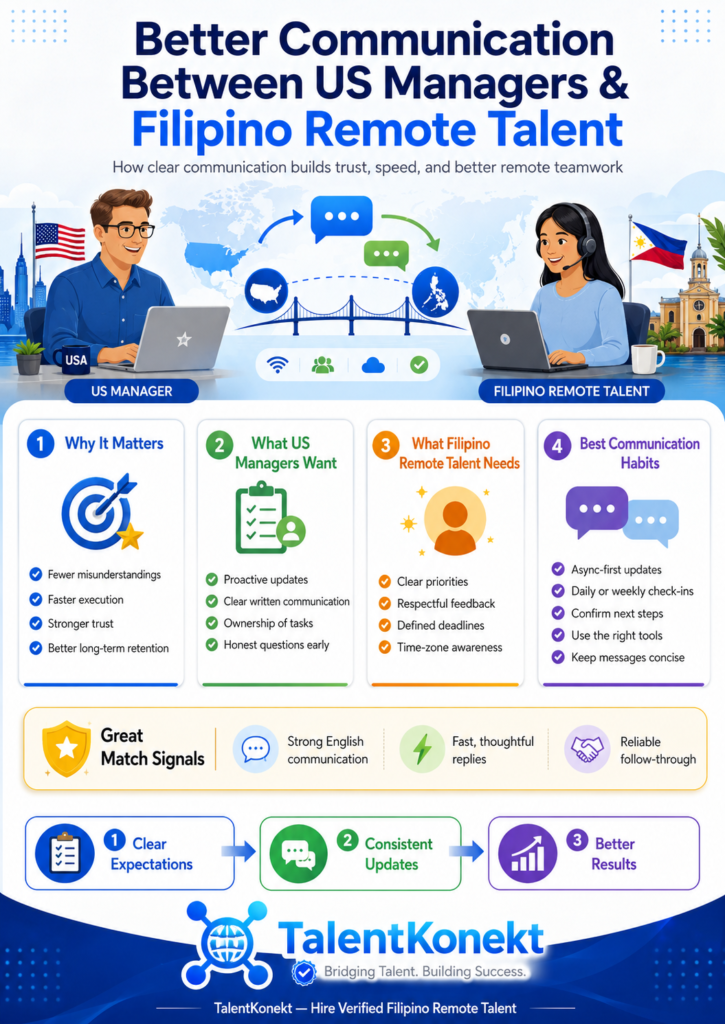
One of the clearest patterns from manager discussions is that communication problems are expensive. Leaders are not only frustrated by silence. They are frustrated by uncertainty, repeated explanations, and constant interruption.
A common complaint is the lack of proactive updates. Managers do not want to chase people just to find out whether work is moving. In one manager discussion, the issue was described very directly: the employee rarely communicated unless the manager reached out first, which created stress and pushed the manager toward micromanagement.
Another frequent frustration is when employees do not read instructions carefully. Managers complain about having to repeat what was already explained in emails or group messages, which wastes time and reduces trust.
At the same time, employers are not asking for endless messages. Too much communication can also be a problem. Managers complain about inbox overload, too many calls, and constant interruptions that make focused work difficult. One manager described a new employee calling 10 to 20 times a day, which turned communication into disruption rather than support.
The real lesson is simple: employers want communication that is clear, timely, useful, and well placed. Not silence. Not chaos.
The hidden cost of weak communication
Poor communication in remote work creates second-order problems that employers hate:
- missed deadlines
- unclear ownership
- duplicated work
- delayed decisions
- too many meetings
- unnecessary follow-up
- manager stress
This is one reason communication matters so much in hiring. Employers know that bad communication does not stay isolated. It spreads into the whole team. Leadership guidance on remote collaboration emphasizes that distributed teams need intentional, structured communication because informal office correction is gone.
That means when employers review a candidate profile, they are often screening for communication risk. They want to know whether this person will reduce friction or create more of it.
What employers want to see in a remote candidate
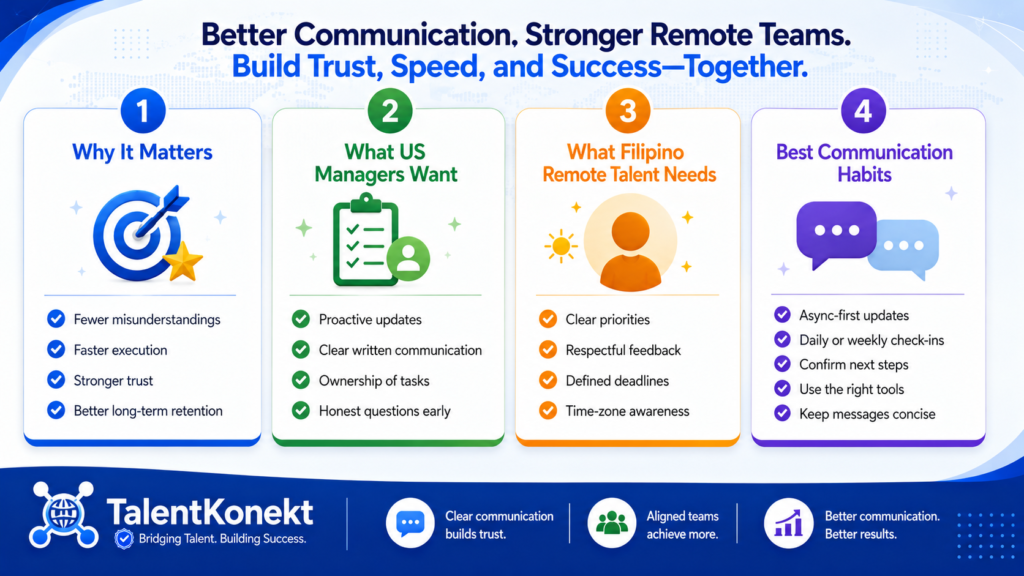
When employers review a remote worker profile, they are usually trying to answer a few practical questions:
1. Can this person communicate clearly in writing?
A profile summary, experience section, and skills list should be easy to understand. If a profile is vague or messy, employers may assume daily communication will be similar. Recruiter guidance for remote candidates repeatedly emphasizes the importance of clear, aligned presentation across profiles and application materials.
2. Does this person give confidence that they can work independently?
Remote employers want signs of self-management. Strong communication supports that by showing that the person can update others, ask good questions, and keep work moving without constant supervision. Indeed’s hiring guidance for remote work highlights self-discipline and self-motivation alongside communication as core traits.
3. Does the candidate understand asynchronous work?
Many remote teams do not want constant meetings. They want people who can write updates, document progress, summarize decisions, and avoid turning every question into a live interruption. Harvard Business Review has stressed that remote collaboration works best when communication is more intentional and often more asynchronous.
4. Is the profile specific enough to trust?
Employers prefer profiles that clearly show role fit, tools, strengths, and work preferences. A specific profile reduces guesswork and makes the candidate easier to match.
Why this matters especially for Filipino candidates
Filipino professionals already have a strong reputation in many remote roles, especially in support, virtual assistance, ecommerce operations, admin work, and customer service. But competition is also strong. The candidates who stand out are usually not the ones with the most exaggerated profiles. They are the ones whose profiles make employers feel at ease.
That means a Filipino freelancer or employee can gain a real advantage by showing:
- clear written communication
- professionalism
- responsiveness
- role-specific skills
- remote-tool familiarity
- a profile that feels organized and complete
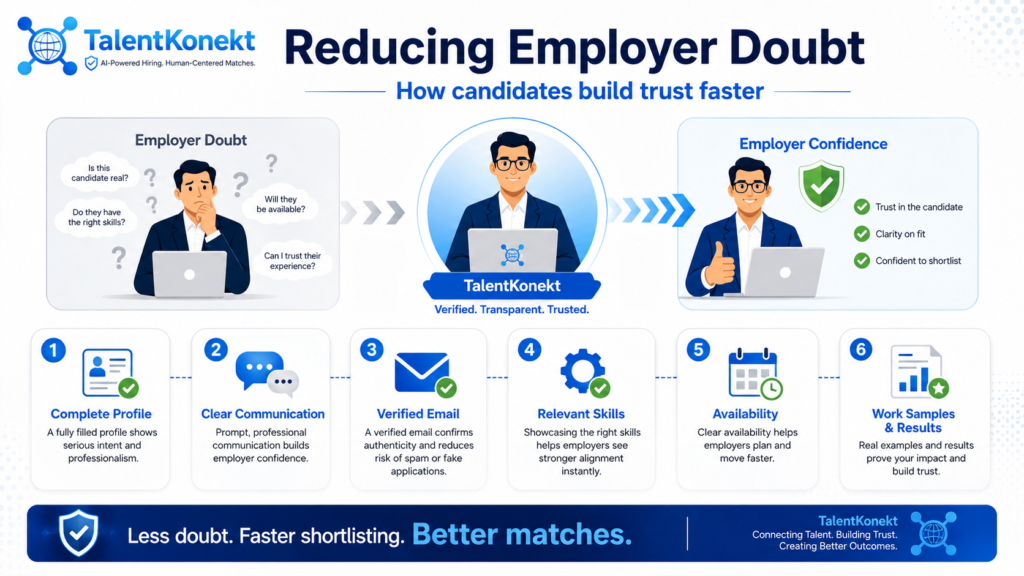
Those qualities reduce employer doubt. And reducing doubt is one of the fastest ways to get shortlisted.
How AI matching changes the game
Remote hiring is becoming more technology-driven. Recruiters and hiring platforms increasingly use AI-assisted matching, search, filtering, and ranking to narrow candidates faster.
For job seekers, this has an important implication: AI matching can only work well if your profile gives it something clear to understand.
If your profile clearly shows:
- what you do
- what tools you use
- what industries you know
- what languages you speak
- what schedule you prefer
- what outcomes you deliver
then AI matching is more likely to connect you with relevant roles. If your profile is generic, incomplete, or inconsistent, matching becomes weaker.
How AI matching can benefit Filipino freelancers and employees
When done well, AI matching can help candidates by:
- surfacing more relevant opportunities
- reducing random mismatches
- helping employers discover skill-specific profiles faster
- connecting candidates to roles they may not have found manually
- improving fit based on tools, communication, availability, and role focus
The key idea is this: AI matching does not replace a strong profile. It amplifies one.
How to prove strong communication in your profile
If employers care so much about communication, your profile should make that visible. Here is how:
Write a clear summary
Do not use vague phrases like “hardworking and passionate.” Explain what you do, who you support, and how you contribute in remote work.
Show remote-ready responsibilities
Mention tasks that show independence and coordination, such as client communication, scheduling, follow-ups, reporting, inbox management, documentation, or support.
List your tools
Include platforms like Slack, Zoom, Trello, Asana, ClickUp, Google Workspace, Excel, Zendesk, HubSpot, Canva, or other tools relevant to your role.
Add language skills
If you speak English fluently, say so clearly. If you can support other languages, include them too.
Keep your profile consistent
Your summary, experience, and CV should tell the same story. Consistency builds trust.
Make availability visible
Show whether you are full-time, part-time, open to US hours, flexible with time zones, or available immediately.
Final takeaway
Strong communication matters more than ever in remote hiring because employers are not just choosing skills. They are choosing how much friction a person will add or remove from the team. Managers repeatedly show the same concerns: no proactive updates, unclear status, unread instructions, and communication overload. Those frustrations shape hiring decisions.
For Filipino freelancers and employees, this is a real advantage if handled well. A profile that shows clarity, responsiveness, remote readiness, and structured thinking can make employers trust you faster. And because our hiring platform relies on AI-assisted matching, that same clarity also helps the system match you to better opportunities.
The best remote worker profiles do not just say, “I can work remotely.” They prove, “I can communicate in a way that makes remote work succeed.”
FAQ
Why is communication so important in remote hiring?
Because employers cannot rely on office visibility and informal interaction the way they do in on-site teams. Clear communication becomes one of the main ways they judge reliability, ownership, and fit.
What communication problems frustrate managers most?
The biggest complaints are lack of proactive updates, unclear status, employees not reading instructions carefully, and excessive or badly structured communication.
How can a candidate show strong communication on a profile?
By writing clearly, keeping the profile consistent, listing relevant tools, showing remote-ready tasks, adding language skills, and making work preferences easy to understand.
Does AI matching help remote job seekers?
Yes, especially when the profile is specific and complete. AI matching is more useful when it can clearly understand the candidate’s role, skills, tools, and preferences.
Why is this especially useful for Filipino freelancers and employees?
Because strong communication and professional clarity help candidates stand out in global remote hiring, where employers want low-friction, reliable team members.
Leave a Reply